
Dorothea Mackellar’s poems
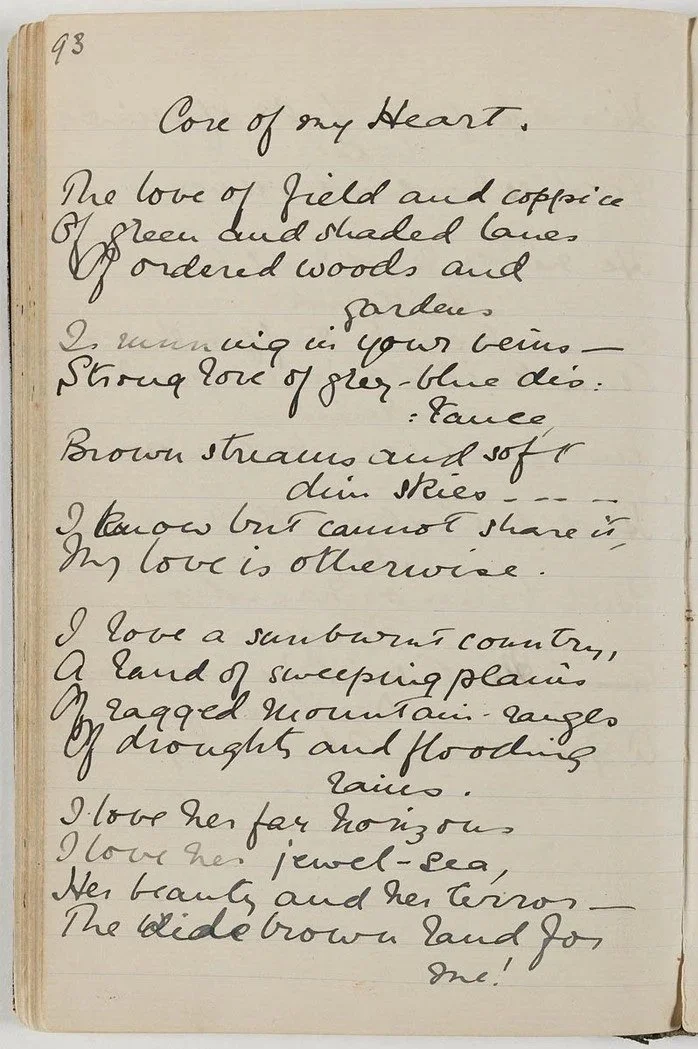
The first draft of what was to become Australia’s most quoted and best loved poem, My Country, was written at age 19 in England at a time when Dorothea was feeling homesick. Published in the London Spectator under the title Core of My Heart in 1908, Dorothea was never quite content with the verses. She wrote, and re-wrote the poem several times after returning to Australia and living in the apartments above her father‘s consulting rooms in Buckland Chambers, Liverpool Street, Sydney, opposite the ANZAC Memorial.
During 1910 – 1920 Dorothea wrote prolifically. 1913 saw a novel Outlaw’s Luck and with Ruth Bedford, a childhood friend, she wrote two other novels, The Little Blue Devil (1912) and Two’s Company (1914). During this time, most particularly through WWII, My Country became hugely popular – appealing to the sense of patriotism fostered by the war and post-war nationalism.
The Australian countryside continued to be a source of inspiration to Dorothea. Two poems that particularly reflected her special relationship with the Gunnedah district are; Dawn (At the dawning of the day; On the road to Gunnedah …), and Burning Off (They‘re burning off at the Rampadells; The tawny flames uprise …).
Dorothea continued to write and travel during the 1920s and early the following decade, her work appearing in publications such as London’s Spectator, the American Harper’s Magazine and Sydney’s The Bulletin among others. During these years, four volumes of her verse were published, The Closed Door (Containing My Country) The Witchmaid and Other Verses,Dreamharbour and Fancy Dress.
She wrote little after the death of her father, and often had extended periods of ill health with which to deal. However, Dorothea’s patriotism, her love of nature, and of regional Australia which she often frequented, was already immortalised. In anyone’s list of most known and most loved Australian poems My Country has featured in top position for over a century.
There is no single universally agreed “complete” public catalogue of every poem written by Dorothea Mackellar, because many works appeared across magazines, newspapers and multiple editions of her collections.
The following list is the most comprehensive consolidated list of her known published poems and major verse titles available from archives and collected editions:
A Bush Christening
A Song of the Wheat
Before the Squall
Dusk in the Domain
Dust-Drift
March Winds
Moonset
Outlawry
Pilgrim Song
Possession
Rain-Music
Reminder
Riding Rhyme
Romance
Seagull
September
Settlers
Sorrow
Spirit of the Bush Fire
Spring on the Plains
Sumer Is Icumen In
Sunset
Swallows
Sydney
The Bride
The Camp
The Closed Door
The Colours of Light
The Coorong Sandhills
The Dreamer
The Explorer
The Gardener
The Grey Lake
The Last Sea-Fight
The Lay of the Motor-Car
The Little Wave
The Moon and the Morning
The Noonday Silence
The Open Sea
The Pharisee
The Road to Ronda
The Santa Maria
The Sea-Breeze
The Storm
The Waiting Life
The Waterfall
The Whispering Bush
To the Dawning
When it comes
Her literary output includes four volumes of poetry:
The Closed Door (1911);
The Witch Maid, and Other Verses (1914);
Dreamharbour (1923); and
Fancy Dress (1926).
She also wrote novels, though Fitzgerald tells us that they were only written ‘for fun’
Outlaw’s Luck (1913),
In collaboration with Ruth Bedford
The Little Blue Devil (1912) and
Two’s Company (1914).